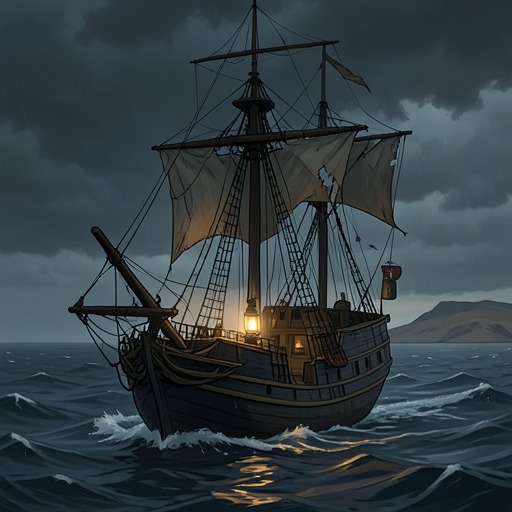
Whaling as an American frontier and imperial project
The WhaleWhaling as an American frontier and imperial project presents the whale fishery as more than a maritime industry: it was a way for a young nation to test its reach against the sea, gather wealth from distant waters, and imagine commercial expansion as a campaign of conquest. The book follows that ambition from the discovery of a new quarry to the global spread of American whaling, while setting its rhetoric of freedom and enterprise against the labor inequalities and ecological losses on which it depended.
The sea as frontier
The project begins with a contradiction. The sea touches cities and shapes human movement, yet it remains a wilderness whose scale and depth resist ordinary knowledge. Its surface can seem familiar or subdued, but beneath it creatures remain largely unseen; its conditions can shift from stillness to force, and it can sustain life while also taking it. The book treats this not as scenery behind human history but as a material limit against which human confidence repeatedly measures itself. To call whaling a frontier enterprise is therefore to describe an effort to enter and exploit a world that was never simply empty or subdued.
That frontier acquired a specific economic focus in 1712, when Christopher Hussey, according to the legend recounted in the book, encountered a sperm whale after his sloop had been blown beyond the usual grounds of the Nantucket fishery. The sperm whale displaced the right whale as the more sought-after quarry. The change brought a new scale and style to the hunt, and an industry already important to the island became increasingly dependent on finding whales farther from shore. By 1730, Nantucket had twenty-five vessels in its fleet; by the end of the century, its whaling trade had become a world leader. The expanding search for prey made the ocean a working frontier: a space entered by ships, mapped through experience, and treated as a source of wealth.
National ambition and commercial reach
The book places that expansion within a broader national story. British observers described the Nantucket fishery as an astonishing achievement by a young people not yet fully established among the older powers. For Owen Chase, first mate of the Essex, whalers were engaged in a war against the ocean’s leviathans. The book draws out the political force of this language: sailors appear as crusaders and knights, while the whale becomes an opponent to be driven before civilization. Such imagery converts extraction into national service and makes the conquest of animals stand for the advance of a new country.
The figures give that ambition a practical scale. In the 1840s, three hundred whale ships sailed from New Bedford, more than half the American fleet. Some returned with two or three thousand barrels of oil, and profits could reach hundreds of thousands of dollars. At the height of the trade, whaling connected ports, investment, labor, shipbuilding, and overseas markets. By 1833, whaling and its associated crafts tied up seventy thousand people and seventy million dollars; a decade later, the figure had nearly doubled. The United States exported a million gallons of oil to Europe each year, and thirty-eight American ports attempted the trade. These networks made the hunt a means of reaching across the world, not merely a local occupation.
In the book’s account, that reach also carried American culture and ideas outward. Nantucket’s houses, shaped by the hazards and prospects of the sea, seem to belong as much to a maritime world as to a settled town. The island becomes the emblem of a society whose business and identity were bound to ocean travel. A later wartime broadcast of Ishmael’s hymn to Nantucket likewise shows how the whaling past could be recalled as a story of national courage. The language of enterprise, danger, and honor helped make commercial extraction look like a heroic inheritance.
Labor, race, and life aboard ship
The frontier was built by a diverse workforce, not by a homogeneous company of American adventurers. The book notes that many sailors in the American whale fishery were born outside the country, and that Africans, Indigenous people, people from the Azores, and Cape Verdeans did much of its labor. In the second quarter of the nineteenth century, one in twenty residents of New Bedford was Black, a higher proportion than in New York, Boston, or Philadelphia. Neighborhood names such as Little Faial and New Guinea registered the port’s varied communities, even as the book describes the unequal conditions under which many sailors worked.
Frederick Douglass’s years in New Bedford make the tension especially visible. After escaping slavery in 1838, he lived and worked there for four years, taking jobs that included rolling casks, stowing ships, sawing wood, sweeping chimneys, and working at a blacksmith’s bellows. The book connects the shipyard to education and possibility for Black men: the working waterfront could serve as a schoolhouse as well as a place of labor. Yet opportunity coexisted with exclusion. Shipboard bunks could be segregated, and racial inequality persisted within an industry whose crews depended heavily on people of color. The whaling frontier was thus neither socially open nor simply an extension of national freedom; its opportunities and burdens were unevenly distributed.
A ship itself was a small, mobile society. On the Charles W. Morgan, space was economized into shelves, drawers, bunks, and compartments; some families travelled aboard, with children doing schoolwork around the mast and daily life continuing amid the ship’s movement. For the lowest-ranking sailors, quarters were far more constrained. Watches divided time, rank shaped accommodation, and the crew might spend years within the wooden boundaries of the vessel. Meetings with other ships, or gams, briefly opened that enclosed world to news and company. The ship carried the frontier with it, but it also imposed a close social order on the people doing the work.
Conquest and its limits
The book presents whaling’s promise of progress alongside the depletion it caused. As land-based expansion drove buffalo toward extinction, the maritime hunt pursued whales toward the brink. The comparison unsettles the idea that the frontier was an empty realm awaiting use: both land and sea were inhabited worlds, and the language of civilization obscured the destruction involved in claiming them. In this account, the warlike vocabulary of the hunt does not merely celebrate skill and danger. It makes visible an attritional conflict in which the animals bore the consequences of a national and commercial project.
The sea also resists the idea that it has been conquered once and for all. The book’s account of humpback migration describes animals travelling as far as eight thousand miles between the Caribbean and the Gulf of Maine, following ancient routes and reaching waters made productive where warm Gulf Stream water meets colder Labrador currents. That movement depends on ocean conditions and inherited routes beyond the control of the hunters. The whales’ return each summer makes the sea not a static storehouse but a changing system whose life exceeds the commercial maps laid over it.
A final contrast appears in the legal treatment of stranded whales in England. Since 1324, whales found on English shores have been treated as royal property, but the modern Receiver of Wreck must often arrange their removal rather than claim a profitable resource. Moving a small stranded whale can cost thousands of pounds; a large one can cost far more. This is not the history of American whaling, but it sharpens the book’s larger account of changing human claims on whales: an animal once valued as a commodity can become a costly public responsibility. Taken together, these episodes show the frontier project’s central irony. The sea supplied wealth and a powerful national story, but its creatures and conditions were never fully subject to human command.